The bright lights, thumping bass, and the rush of a near-miss—online pokies are the heartbeat of Australian digital entertainment in 2026. But behind the vibrant themes and high-definition animations lies a sophisticated, invisible engine that ensures every spin is a “fair go.”
That engine is the RNG (Random Number Generator). If you’ve ever wondered if a machine is “due” for a win or if playing at 3 AM changes your luck, you’re essentially asking about how RNG works. In this expert review, we’re lifting the hood on the mathematics of the modern pokie to explain the science of randomness and why it’s your best guarantee of a fair game.



What is RNG? The Brain of the Pokie
RNG stands for Random Number Generator. In the context of online gambling, it refers to a complex mathematical algorithm that produces a sequence of numbers that cannot be reasonably predicted.
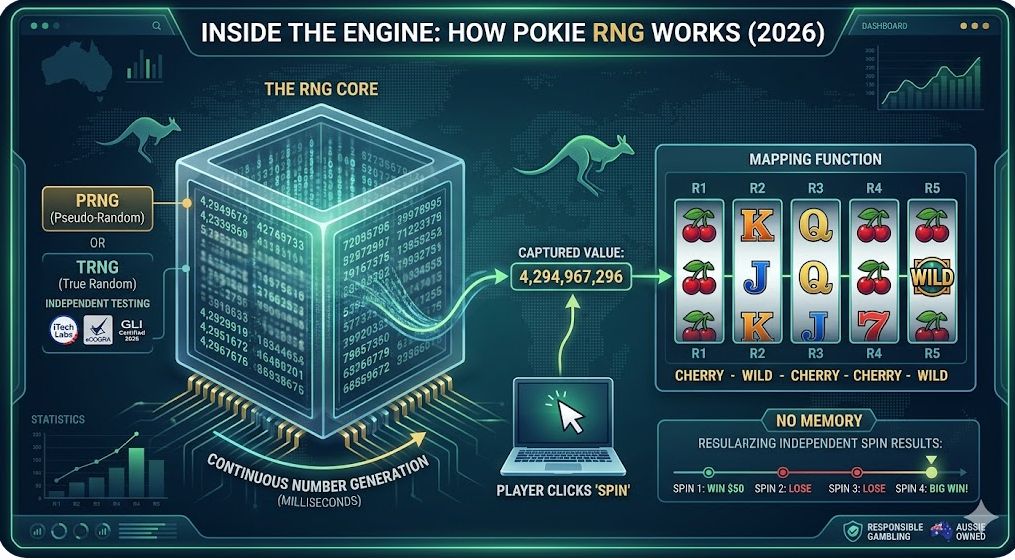
Every single millisecond, even when no one is playing, the RNG is “spitting out” thousands of numbers. When you click that “Spin” button, the software catches the most recent number generated at that exact micro-second. That number is then mapped to a specific outcome on the reels.
The Two Types of RNG
Not all randomness is created equal. Depending on the tech behind the casino, you’re usually dealing with one of two types:
-
PRNG (Pseudo-Random Number Generator): This is the most common type used in online pokies. It uses a “seed” value (often derived from the system clock or a hardware indicator) and an algorithm to create a massive string of random-looking numbers. Modern PRNGs are so advanced that they are statistically indistinguishable from “true” randomness.
-
TRNG (True Random Number Generator): These use physical phenomena, like atmospheric noise or thermal fluctuations, to generate numbers. While highly secure, they are rarely used for standard pokies because PRNGs are more cost-effective and easier to audit for regulatory compliance.
How the “Spin” Actually Happens (Step-by-Step)
To understand the RNG, let’s look at what happens in the split second between your click and the win:
-
The Continuous Loop: The RNG algorithm is running 24/7. It doesn’t “rest” while the game is idle.
-
The Command: You hit “Spin.”
-
The Capture: The software grabs the latest value from the RNG. Let’s say it captures the number
4,294,967,296. -
The Mapping: The game’s internal “map” translates that massive number into coordinates for each reel. For a 5-reel pokie, it might tell Reel 1 to stop on the Cherry, Reel 2 on the Jack, and so on.
-
The Result: The reels spin visually on your screen merely as a courtesy—the outcome was actually decided the moment you clicked.
Debunking the “Hot” and “Cold” Myths
Because Aussies love a yarn, several myths have persisted about how pokies work. Thanks to RNG technology, we can officially put these to bed:
Myth 1: “The machine is due for a win.”
The Reality: RNGs have no memory. They don’t know if you just won the $10,000 jackpot or if you’ve lost 50 spins in a row. Every single spin is a “Fresh Start.” The probability of hitting the jackpot is exactly the same on every spin, regardless of history.
Myth 2: “Casinos can flip a switch to make machines tighter.”
The Reality: In 2026, regulated Australian-friendly casinos use games hosted on the provider’s servers (like Pragmatic Play or Relax Gaming), not the casino’s own. The casino operator has no access to the RNG code. To change the “tightness” (RTP), they would have to swap the entire game version, which is a process heavily monitored by auditors.
Myth 3: “Stopping the reels manually changes the outcome.”
The Reality: When you click “Stop” to skip the animation, you aren’t changing the result. You are simply telling the software to show you the result the RNG already decided faster.
Who Watches the Watchmen? RNG Certification
You shouldn’t just take a casino’s word that their RNG is fair. Licensed operators must submit their software to independent testing labs for rigorous “stress tests.” If you see these logos at the bottom of a casino site, you’re in safe hands:
-
eCOGRA: The gold standard in London-based testing.
-
iTech Labs: An Australian-founded global leader in gaming certification.
-
GLI (Gaming Laboratories International): They ensure the math holds up across millions of simulated spins.
These agencies run billions of test spins to ensure that the actual payout matches the theoretical RTP (Return to Player) and that no patterns emerge in the number sequences.
RNG, RTP, and Volatility: The Holy Trinity
While RNG handles the randomness, it works in tandem with two other factors to define your experience:
-
RTP (Return to Player): The percentage of stakes the RNG is programmed to return over the long haul (e.g., 96%).
-
Volatility: How the RNG distributes those wins. High volatility means the RNG is programmed to deliver “clumpy” wins (big but rare), whereas low volatility means the RNG spreads the wins out more evenly.
-
Weighting: Not every symbol on a virtual reel is represented equally in the RNG. A “Wild” symbol might only correspond to 1 out of 100 possible numbers, while a “10” symbol might correspond to 15. This is how providers create different “hit frequencies.”
Why “Provably Fair” is the 2026 Trend
A new shift in the Australian market is the rise of Provably Fair gaming, often found in crypto-friendly casinos. This tech allows you to verify the randomness of your own spin.
It works using a “hashing” system:
-
The casino provides a “Server Seed.”
-
Your browser provides a “Client Seed.”
-
The two are combined to create the result.
After the spin, you can check the “hash” to prove that the casino didn’t change the outcome after you placed your bet. It’s the ultimate transparency for the modern punter.
Final Expert Verdict: Should You Trust the Tech?
In 2026, the technology behind online pokies is more secure than it has ever been. The transition from mechanical gears to digital RNGs has actually made the games fairer for the player by removing physical wear-and-tear that could bias a machine.
When you play at a certified, licensed site, you aren’t fighting a “rigged” system. You are engaging with a high-speed mathematical marvel designed to give everyone an equal shot at the jackpot. The RNG doesn’t care who you are, how much you’ve spent, or what time it is—it just gives you the luck of the draw.